
South Korea’s President Condemns Prosecutorial Abuse
by Rev. Demian Dunkley
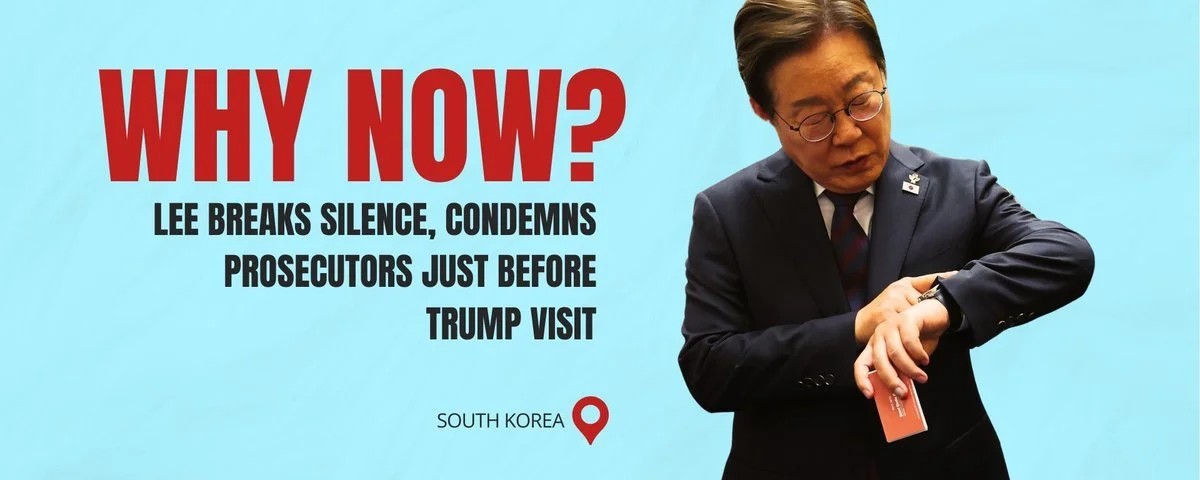
South Korea’s president broke months of silence this week, condemning prosecutorial abuse in a Cabinet meeting—just days before President Trump’s visit.
If President Lee said in Washington that he could not interfere with a special prosecutor, why is he suddenly denouncing prosecutorial abuse now, just before President Trump arrives in Korea? And if he truly believes innocent people are suffering under unfair investigations, why didn’t he speak sooner, while they languished in detention?
In August, during his White House visit, President Lee Jae-myung told President Trump that the prosecutions unfolding in Korea were beyond his reach. They were the domain of an independent special prosecutor. The message was simple: the law must take its course, and the head of state could not intervene.
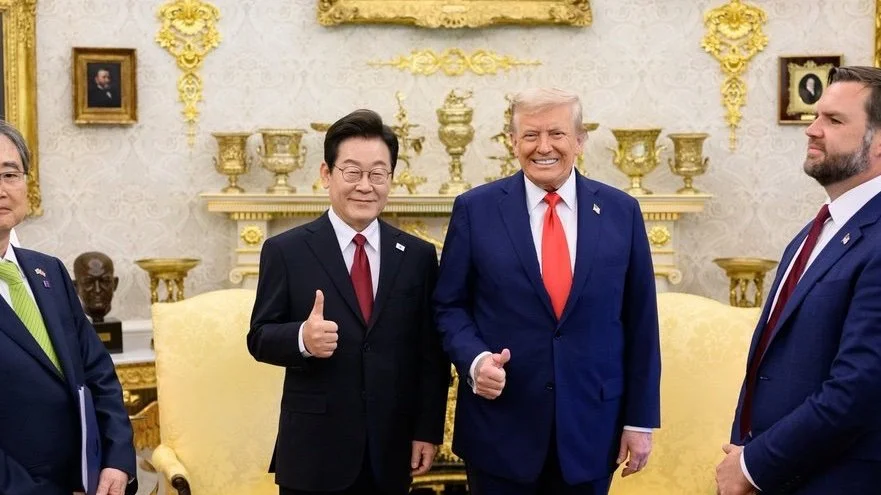
Trump Lee meeting in the Oval Office, August 25, 2025
Trump, who has often warned of “lawfare” in his own country, compared the Korean inquiry to the cases brought against him. “Is his name Jack Smith?” he asked.
On October 30th, the same President Lee used a very different tone. At a televised Cabinet meeting, he condemned prosecutors for “collapsed standards,” for “indicting baseless cases,” and for making “the state cruel to its people.” He called for institutional reforms to stop such abuse. The contrast between those two postures—hands-off in August, reformist in October—is striking.
What Happened Between Those Moments
Public records show that during that short interval:
July 18 — Special-prosecutor teams raided major religious institutions, including the Unification Church, Yoido Full Gospel Church and Far East Broadcasting Company.
September 9 — Pastor Son Hyun-bo of Segero Church was arrested in Busan.
September 22 — Dr. Hak Ja Han, an 82-year-old religious leader, was taken into custody and later indicted on financial-misconduct charges she denies.
October 10 — A local official who had been interrogated by the same prosecutorial team was found dead, leaving notes that alleged intense pressure.
Until then, the administration had defended the independence of these investigations. Only after these events, and only days before President Trump’s return to Seoul, did the president speak of “cruelty” and “innocents suffering.”
Why now?
The International Response
The reversal has not gone unnoticed abroad. In The Washington Times, former U.S. House Speaker Newt Gingrich described President Lee’s October remarks as a “shocking admission of injustice,” noting that they followed months of pressure and growing U.S. concern about religious freedom in Korea. Whatever one’s politics, the timing raises its own questions about cause and conviction.
Please, Someone—Answer These Questions
Political observers note that President Lee’s new language closely mirrors the rhetoric of those who have accused him of weaponizing the legal system. It could be moral reckoning—or projection, condemning in others the behavior critics associate with his own government. Either way, these are some valid questions:
Is this moral reckoning—or political self-preservation?
If the system was beyond presidential influence in August, what changed by late October?
Did conscience awaken, or did international attention force a response? If compassion is genuine, why did it arrive only when cameras returned to Seoul?
Why was there no such concern while elderly detainees were interrogated or when a civil servant’s death exposed the cost of prosecutorial pressure?
Either interpretation leaves a deeper question: in a democracy built on legal integrity, what happens when law becomes the theater of politics and compassion becomes choreography?
Beyond Words
For those still in confinement, statements from the Blue House change nothing. True reform would begin with the people already suffering under the procedures the president now condemns. The measure of leadership is not in who accepts blame after the fact, but in who acts when silence is easier.
So again, the ultimate question remains:
If President Lee said in Washington that he could not interfere with a special prosecutor, why is he denouncing prosecutorial abuse now—just before President Trump arrives in Korea? And if he truly believes innocent people are suffering under unfair investigations, why didn’t he speak sooner—while they languished in detention?
(All information drawn from publicly available reporting in The Chosun Ilbo, Korea JoongAng Daily, MK Business News, Biz Chosun, Yonhap News TV, and The Washington Times, October 2025.)