
Dec. 1 Court Observation Report of Dr. Han's Case
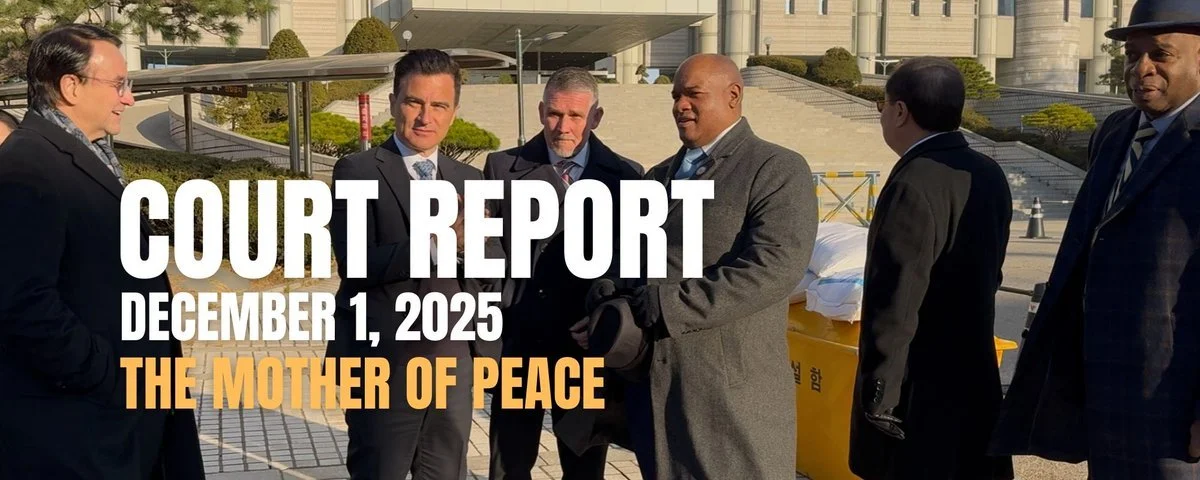
by Rev. Demian Dunkley
Dec. 1 Court Observation Report – Dr. Han Case
Inside the December 1 Hearing: What Unfolded in the Dr. Han Case
The first substantive hearing for Dr. Hak Ja Han and three co-defendants took place on December 1, 2025, at the Seoul Central District Court, drawing significant media interest and a long line outside the courtroom even before proceedings began. The morning session, held from 10:10 to 11:40, provided the clearest view yet of the prosecution’s strategy, the defense’s overarching rebuttal, and the court’s approach to managing a complex, high-profile trial.
Defendants and Legal Teams
Four defendants appeared: Dr. Han, Jung Won-joo, Yoon Young-ho, and Lee Shin-ae. Dr. Han was represented by two major law firms—BKL and Pyeongsan—fielding a combined fifteen attorneys. The prosecution’s team consisted of the Special Prosecutor and three supporting prosecutors.
After confirming the identities of all defendants, the court advised them of their right to remain silent. Each declined the option of a jury trial.
Prosecution Outlines Six Categories of Charges
The Special Prosecutor opened with an extensive summary of the alleged crimes, framing Dr. Han as the central figure in a network of political and financial misconduct. The charges fall into six main groups:
Political Funds Act violations and embezzlement related to cash allegedly provided to Rep. Kweon Seong-dong.
Split-donation scheme involving the division of contributions to multiple political figures.
Gifts to First Lady Kim Keon-hee, framed as a violation of the Improper Solicitation and Graft Act and accompanied by embezzlement allegations.
Evidence destruction, specifically the deletion of accounting records tied to a past overseas casino event.
Embezzlement involving payments to foreign politicians, notably in Senegal, under the Aggravated Punishment of Specific Economic Crimes Act.
Workplace embezzlement concerning internal “gift money” funds.
Co-defendants Jung and Lee were separately accused of personal embezzlement—approximately KRW 2 billion in Jung’s case and KRW 145 million in Lee’s.
The prosecution portrayed Dr. Han as the organization’s “supreme authority,” describing a structure in which “not a single won could be moved” without her approval. Jung was positioned as a “gatekeeper,” while Yoon was depicted as the executor of the alleged scheme.
Political Motive Allegations
The prosecution asserted that the group sought influence in two directions:
Toward the National Assembly, allegedly approaching Rep. Kweon “using votes as a bargaining chip.”
Toward the Presidential Office, allegedly attempting to create access to First Lady Kim Keon-hee and President Yoon Suk-yeol.
Prosecutors cited meetings and phone calls as evidence of improper religious–political entanglement, arguing that the conduct violated Korea’s constitutional separation of religion and state.
At one point the prosecutor added a pointed remark that church members had donated “using their jeonse (housing deposit) funds”—a statement with no legal relevance but clear emotional effect.
Defense Pushes Back: “This Case Begins With Yoon, Not Dr. Han”
Dr. Han’s legal team presented a sharply different view of the case, arguing it originated entirely from Yoon Young-ho’s personal political ambitions and his unilateral activities. The defense stressed that:
The doctrine cited by prosecutors reflects Yoon’s personal interpretations, not official teaching.
Dr. Han never advocated “theocracy,” nor did she ever claim that political leaders must obey her.
Statements such as “politics and religion must become one” referred to cooperative values, not institutional domination.
Charge-by-Charge Denial
The defense rejected every major allegation:
Political donations / split donations: Dr. Han did not receive reports about such activities, which were handled by Yoon. Funds used were for church purposes, not personal or political gain.
Gifts to Kim Keon-hee: Dr. Han gave no instruction to purchase gifts. Yoon selected the items, purchased them using Lee’s credit card, and withdrew excess funds—suggesting personal misuse.
Evidence destruction: The “casino” event was a one-time recreational activity; there was no motive to hide it. The defense claims Yoon deleted records to cover his own embezzlement.
Foreign payments: Transfers to overseas figures were framed as missionary or humanitarian aid, not political contributions.
Court Interventions and Requests
The court demonstrated a focus on structure and efficiency. It directed both parties to cooperate in several areas:
Witness schedule: About 12 witnesses will be examined. The court suggested grouping witnesses and handling document authentication first to streamline the process.
Clarification of denials: Defendants must submit written clarification specifying exactly which allegations they dispute.
Foreign political contributions: The court requested briefing on whether religious organizations can legally make such contributions abroad, and whether Korea’s Political Funds Act applies extraterritorially.
Electronic evidence: Defendants must state whether messages, recordings, and emails are authentic or disputed.
Doctrinal terminology (“Chili/Chiri/Ch’ili”): The prosecution argued the term is general, meaning “governance” or “discipline,” not doctrinal.
Atmosphere in the Courtroom
The hearing drew notable attention, including several foreign correspondents, some from Japan. Court officers halted attempts to record inside the courtroom, and overall proceedings were orderly and restrained.
Afternoon Session
The hearing was scheduled to continue in the afternoon with remote testimony from witness Seo Hyun-wook, who requested not to face the defendants in person. A bail hearing was also expected to follow.