
They Pulled the Wrong Thread: And the Curtain Came Down
by Rev. Demian Dunkley
The last several days have reshaped the entire landscape of what has been called the Unification Church case. What was once portrayed as a narrow scandal aimed at a single political camp has now opened into a wider and far more revealing picture. Testimony, photographs, and courtroom exchanges have shown that the political contacts in question did not occur on only one side. Figures from both major parties were participating in similar interactions, often around the same events and with the same individuals.
This is no longer an assumption or a defensive claim. It is a matter of public record. Political actors from the ruling party and the opposition both attended international gatherings connected to the church, both sought access to global guests, and both engaged in forms of political contact that were initially described as the exclusive wrongdoing of one camp. The facts have expanded far beyond the original frame, and the question now before the country is straightforward: what exactly is the legal standard being applied?
It should also be clarified that maintaining relationships across the political spectrum has long been part of the vision articulated by our founders. The Unification movement has consistently described this approach as head-wing, meaning an effort to rise above left-right divisions by emphasizing shared moral principles rather than partisan ideology. Those principles, stated publicly for decades, include the centrality of strong families, respect for human dignity, responsibility in public life, reconciliation across lines of conflict, and a commitment to peace that transcends national, religious, and political boundaries. As with any religious community, individual members are fully entitled to their own political views and affiliations. Institutionally, however, the movement has sought to promote values, not political agendas. Any irregular or unsanctioned actions by individuals do not change that orientation.
Once this context is understood, the legal dilemma becomes unavoidable. If certain political interactions are illegal when one party engages in them, then they must also be illegal when the other party does the same. If those interactions are lawful, then they cannot support criminal liability for the person who carried them out, let alone for someone who stood several steps removed from those actions.
"No justice system can operate on two opposing interpretations of identical conduct."
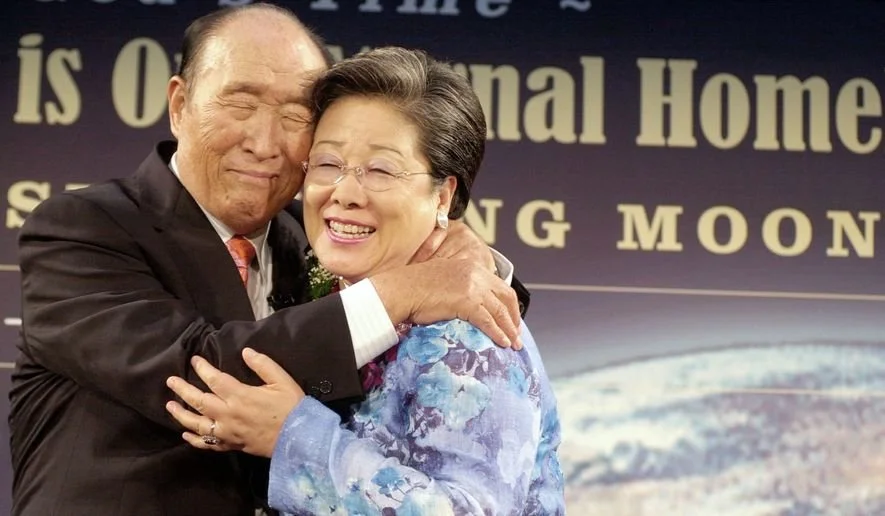
Rev. and Mrs. Moon (Dr. Hak Ja Han)
Dr. Hak Ja Han is far removed from the operational details now under scrutiny. If the conduct itself is lawful, there is no basis for holding her responsible. If the conduct is unlawful, it cannot be prosecuted selectively.
"Either way, the original structure of the case no longer holds. It depended on a simple storyline that the facts no longer support."
I doubt most Koreans are following every detail of this case. People are busy, and they judge situations through a basic sense of fairness. They should be able to see the danger of a government continuing to rely on a theory that no longer aligns with the evidence emerging in court. Public trust depends on consistency. When the story changes but the prosecution does not, confidence erodes.
At this point, it is reasonable to ask a direct question. Who stood to gain from maintaining the earlier narrative as long as possible, a narrative that framed this as a one-sided problem with a single convenient culprit? And now that the record has widened and the bipartisan reality is harder to deny, who appears most unsettled by that shift?
Political narratives are not neutral. They create incentives and advantages. A simplified story benefits those who need clarity more than accuracy and control more than complexity. When that story begins to break down, the reactions that follow often say more than the story itself.
As the evidence broadened, it became clear that the focus on the church did not explain the larger political dynamics at work. Ordinary forms of engagement that had existed for years were suddenly isolated and reframed as exceptional. This made the case easier to manage and easier to use. By keeping attention fixed on the church, deeper questions about political conduct across party lines were pushed aside. What was presented as reform began to look like the tactical use of prosecution to manage political risk.
Warnings about this danger are not coming only from within our own community. Christian leaders from other denominations have spoken publicly in recent days, reminding the country that dissolving a religious organization is not an executive function in a constitutional democracy and that collective punishment violates basic legal principles. Their concern is not about defending one church. It is about protecting the boundary between state power and freedom of belief.
What this increasingly resembles is not a corruption scandal that grew too large, but a deeper political struggle that was already underway. In that struggle, the church became the visible point of focus while more consequential political objectives moved underneath.
"The willingness to continue holding an 82-year-old peace leader as this process unfolded raises a troubling question about what the system was prepared to tolerate in order to preserve its narrative."
The testimony that emerged did not expose the church. It exposed the gap between the story the public was told and the reality operating behind it. Once that gap became visible, the strategy that depended on concealment could not survive.
They pulled the wrong thread, and the curtain came down. The question now is how long a collapsing narrative can continue to be held in place by keeping an 82-year-old, world-renowned Mother of Peace at its center.
"When a government continues to press a case after its own narrative has collapsed, the question is no longer about accountability, but about whether power can still recognize its limits."
Sources and Background
This article draws on a combination of court records, mainstream Korean media reporting, official government statements, expert legal analysis, and publicly documented humanitarian and medical assessments.
Court Proceedings and Legal Record
Seoul Central District Court trial proceedings involving Dr. Hak Ja Han, including witness testimony and judicial questioning regarding the applicability of political funds laws and the scope of alleged conduct.
Court pool reporting documenting the expansion of implicated political actors across party lines and the court’s recognition of legal inconsistencies.
Mainstream Korean Media Reporting
KBS News: Coverage of allegations extending to both ruling and opposition party figures, and reporting on political responses to claims of selective investigation.
Hankyoreh: Analysis of prosecutorial conduct, political implications of the investigation, and concerns regarding overreach.
Segye Ilbo: Reporting on testimony related to political donations and contacts involving multiple parties.
Yonhap News Agency: Coverage of raids, detentions, and official statements.
Korea Times / Korea Herald / JoongAng Daily: Court analysis and editorials raising concerns about prosecutorial independence and political intrusion.
AsiaToday: Editorial commentary warning about the perception and risks of religious oppression following government rhetoric.
Government Statements and Political Context
Televised Cabinet meeting statements in early December 2025, in which the President discussed the dissolution of religious organizations and instructed ministers to review Japan-style legal approaches.
Public statements and actions by ruling and opposition party officials responding to the investigation, including a reported ministerial resignation amid growing controversy.
Religious Freedom and Civil Society Responses
Public press conferences and statements by Christian leaders from multiple denominations opposing dissolution rhetoric and warning against collective punishment of religious communities.
Inter-denominational commentary emphasizing constitutional protections for freedom of religion and the dangers of precedent-setting state action.
Humanitarian and Medical Documentation
Medical Opinion by Dr. Samia Burton, MD (October 22, 2025), detailing serious cardiovascular and systemic health risks associated with continued detention and adverse conditions.
Reports comparing detention conditions with established medical and geriatric standards, highlighting risks posed to elderly detainees.
Prior Analysis and Contextual Work
Previous published op-eds and analyses by the author on religious freedom, prosecutorial practice, and the treatment of faith communities in Korea, including “Release the Mother of Peace” and related commentaries.
Research on the structure and evolution of South Korea’s special prosecutor system and its susceptibility to politicization in high-profile cases.
Comparative references to Japan’s dissolution of religious organizations, cited for context regarding legal precedent and public controversy.