
Release the Mother of Peace
by Rev. Demian Dunkley
It Is Time for Korea to Aim at the True Threats to Its Future, Not at an Elderly Religious Leader Who Has Harmed No One
When I try to reduce the entire case against Dr. Hak Ja Han to a single phrase, nothing captures it more accurately than this familiar Korean expression: “fire, ready, aim.” It describes acting before thinking—and that is exactly what has unfolded from the very beginning of this investigation.
The premise is simple and, by now, difficult to dispute. From the beginning, this investigation moved in a direction that had little to do with measured justice. It was selective in the targets it pursued, unusually aggressive in its methods, and propelled by leaks that shaped early media narratives long before any evidence was tested in court. Those narratives are now giving way as new facts emerge. What is happening now is clear: both the government and the prosecution have revealed a politically motivated purge, and when such an effort is directed at a major religious figure and her movement, it matches exactly what the international community recognizes as religious persecution.
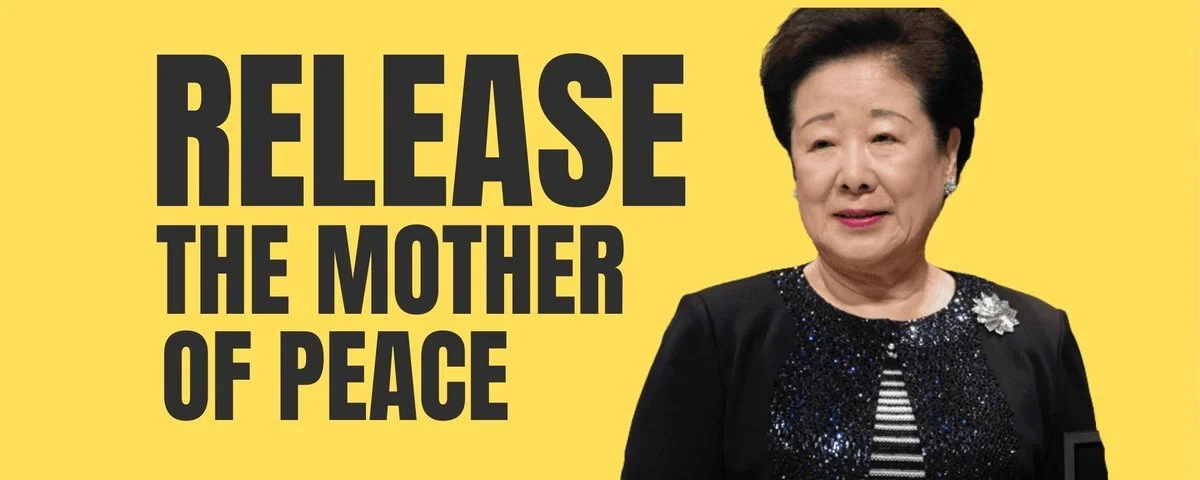
This is why I believe Dr. Han, the Mother of Peace, should now be released, acquitted, and offered an apology. From there, we should work with other churches and civic leaders to safeguard the religious freedoms of all Koreans, whether they be religious or not. As Pastor Mark Burns put it, "It’s not just about your freedom of religion; it’s about your right to be free."
It should now be clear to anyone who has been watching. The pattern we have witnessed since July becomes unmistakable: it was not the slow, careful work of justice, but a sequence of shots fired followed by poor explanations.
1. July 18: A Show of Force Before a Show of Proof
On July 18, nearly one thousand officers descended on the Family Federation’s spiritual sanctuary in Gapyeong. To many observers, it looked less like a legal search and more like a political show of force. Without warning or substantive explanation, the church was treated as if it were an enemy of the state rather than a religious community.
Believers and non-believers alike watched in disbelief as sacred spaces were swept through with riot shields and evidence bags. The Mother of Peace’s private room was entered and searched as if it were part of a battlefield. No indictment had been issued, and no coherent legal theory had been presented. Force arrived long before proof.
What followed only deepened these concerns.
It was the first sign that the strategy behind this case was less about truth than about optics. And if one asks why nearly a thousand officers in riot gear were required, the implied answer seems to be that a peaceful religious workshop posed the kind of danger that demanded a battlefield response.
2. Solitary Confinement for the Mother of Peace
What followed made the direction of this case even harder to justify.
Dr. Hak Ja Han, the Mother of Peace, an 82-year-old widow, nearly blind, with a history of heart complications, was placed in near-solitary detention in the Seoul Detention Center. She slept on blankets on a hard floor in a small cell with no bed or chair. She struggled to eat. Her blood pressure spiked under stress. Her mobility and vision deteriorated. And even after eye surgery, she was returned to the same harsh conditions within days.
This would be troubling treatment for any detainee, but for an elderly religious leader who has not been convicted of a crime, it raises profound moral questions. These are not the conditions under which democracies pursue justice. They are the conditions under which democracies lose their way. And if one asks why such confinement was necessary, the implied explanation appears to be that an 82-year-old grandmother posed a national threat so great that compassion could not be afforded.
3. A Case Built on Inference and a Single Insider
After all the raids, all the headlines, and all the dramatic accusations, the prosecution’s case rests on remarkably little.
There is no direct instruction from Dr. Han ordering anyone to give illegal donations or gifts. There is no verified chain of custody linking the alleged luxury items to a quid pro quo. There is no corroborating evidence tying her personally to criminal intent. The prosecution leans heavily on one insider who has every incentive to shift responsibility upward, a pattern frequently seen when defendants hope for leniency.
Even the former First Lady denies any exchange of favors. And according to courtroom reporting, the presiding judge has openly asked whether the law being used to charge Dr. Han even applies to religious foundations in the manner the indictment assumes.
When a judge must ask whether the statute fits the accusation, the case is already strained. And if one asks why the prosecution pushed forward anyway, the only answer seems to be that, in the absence of clear evidence, presumption was expected to stand in for proof.
4. The Smoking Gun: Selective Prosecution Revealed
And now, in recent days, the core weakness of this investigation has come fully into view.
Multiple Korean outlets now report that Yun Young-ho, the former world headquarters director at the Family Federation, told the special prosecutor months ago that the Church provided financial support not only to lawmakers in the conservative People Power Party (PPP), but also to as many as fifteen lawmakers in the progressive Democratic Party (Minju Party). Yun’s testimony reportedly included cash, official donations, bulk book purchases, and even occasions when Democratic Party lawmakers visited Cheon Jeong Gung, met Dr. Han personally, and were later said by Yun to have received tens of millions of won from church funds.
More importantly, Yun says he submitted the names of four current minister-level officials and several lawmakers from the ruling party.
And yet the special prosecutor:
• opened no investigations into any Democratic Party figures
• recorded none of this as formal testimony
• kept Yun’s statements only as internal notes, suggesting they never intended to act on them.
Legal experts, including former high prosecutors now in private practice, have begun using language no one expected to hear: if a special prosecutor has credible testimony implicating lawmakers in both parties but chooses to pursue only one side, this is not merely selective. It may constitute dereliction of duty under the Special Prosecutor Act, which requires investigation of any related crimes uncovered.
What makes this even more troubling is the contrast. When Family Federation supporters donated to opposition figures in the conservative People Power Party (PPP), the result was raids, indictments, and the pre-trial jailing of an elderly religious woman. When similar support went to current ruling-party figures, it disappeared into silence.
Same church. Same funds. Same networks. A completely different standard.
There is also a broader structural reality in Korean public life that cannot be ignored. Unlike the United States, where lobbying is regulated and transparent, Korea’s prohibitions leave religious, civic, business, and cultural groups without clear legal avenues to communicate their concerns to lawmakers. This ambiguity has shaped political life for decades. If political giving occurred, it should be understood within this systemic context and addressed consistently, not selectively. Enforcing prohibitions only when one faction receives the support is not a defense of democracy; it is the misuse of democratic mechanisms. And if one asks why Yun's testimony about ruling‑party figures was set aside, the response appears to ask us to believe that only opposition-party actions are illegal, but not for those in power.
This is not even the appearance of fairness. It is political engineering under the guise of prosecution.
5. A Special Prosecutor Under Its Own Shadow
The special prosecutor system was created because the public no longer trusted the ordinary prosecution to investigate politically sensitive cases. It was meant to restore balance and independence. Yet the Kim Keon-hee Special Prosecutor now finds itself facing the same criticisms once directed at the institutions it was meant to replace.
Editorial boards are asking why testimony implicating ruling-party politicians was not properly recorded or investigated. Former prosecutors are saying openly that the special counsel followed the old pattern: expand aggressively when targeting one faction, avoid uncomfortable evidence involving the other. There are even discussions about whether a second, broader special investigation will be required to examine what this special prosecutor chose not to pursue.
Instead of restoring trust, the special prosecutor has become part of the trust crisis.
6. December 2: The President Said the Quiet Part Out Loud
Against this backdrop came the most revealing moment yet.
On December 2, in a televised Cabinet meeting, President Lee Jae-myung declared that certain religious foundations had engaged in unconstitutional political activity. He instructed his ministers to study Japan-style dissolution measures for religious organizations. He cited Japan’s dissolution of the Unification Church as a model. And he warned that if these actions were not addressed, Korea could face something like a “religious war.”
This took place within 24-hours of Dr. Han’s trial launch. Before evidence had been weighed. Before cross-examinations. Before the legal process could even begin in earnest.
It framed the trial not as a judicial matter, but as a national security threat. And it pointed not to Korean legal tradition for guidance, but to Tokyo.
For a nation whose prosecution system was built atop Japanese colonial architecture, the symbolism is striking. Recently I wrote that Korea’s legal reflexes still mirror aspects of the old imperial model. Now, in 2025, the president invoked Japan’s most controversial action against a religious movement as the precedent for Korea to consider.
Even progressive papers reacted with concern. AsiaToday warned that such rhetoric risks generating perceptions of religious oppression. The Korea Times urged political leaders not to intrude into religious life, especially during an ongoing trial.
The president’s words did what months of legal analysis could not: they made clear that this case is political at its core. And if one asks why dissolving churches should be considered in the midst of a trial, the only rationale offered was the specter of a “religious war”—a claim that reveals far more about political anxiety than public danger.
7. This Was Never About One Church — It’s About Everyone’s Freedom
When a state misdirects its aim at a harmless religious leader, the danger is not confined to one movement. It spreads to every community that depends on the protections of a free society. We have already seen this. On the same day Gapyeong was surrounded by a thousand officers, police also raided Segero Church, ministries associated with Yoido Full Gospel Church, and even Far East Broadcasting. These communities had no connection to the allegations involving Dr. Han, yet they too saw their sanctuaries turned into scenes of investigation, revealing how easily unrelated religious communities could become stepping stones towards political targets.
A government that can do this to one religious body can do it to any religious body. What happened on July 18 was not an isolated action; it was a demonstration of both capacity and willingness. It revealed the scope of authority the state is prepared to use when it believes its target will not be defended.
If the government can:
raid churches with overwhelming force,
place elderly religious leaders in solitary confinement without direct evidence,
enforce political funding laws selectively,
jail religious leaders for preaching their values,
borrow Japan’s harshest tactics against religious organizations, and
justify it all with warnings of “religious war,”
then the issue extends far beyond one church or one trial. A government that can do these things to one community can do them to any community. It touches the foundation of freedom itself.
Korea’s democracy has thrived on its commitment to rights that protect even unpopular minorities. That commitment is now being tested. Freedom of religion has always been the canary in the coal mine. Once it falls, other freedoms soon follow.
I have even heard it said, among those who study democracy in Asia, that South Korea itself is viewed as the canary in the coal mine for religious freedom and humanitarian protections in the region. When Korea stands firm, others take notice; when Korea hesitates, others follow. And when Korea shows a willingness to compromise on these protections, who else can truly feel safe?
Dear readers, this narrative has now reached its critical point.
8. What We Must Do Now — Together
To everyone following this journey, members of the Family Federation, friends of religious liberty, and citizens concerned for Korea’s future, I suggest three things.
A. Stay clear. Do not let noise or confusion cloud the reality now in plain sight. The facts are visible. The contradictions are undeniable. The narrative arc is revealing itself.
B. Pray for courage, especially for the judge. He carries a profound responsibility and faces extraordinary pressure. Pray that he has clarity, independence, and calm. Bail is the decision that restores balance and affirms judicial dignity.
C. Understand the stakes. There are too many highly esteemed leaders who will guarantee for you that this is not simply a legal trial. It is the hinge on which Korea’s relationship to faith and freedom will turn.
I say this without hesitation: the weaknesses in this case are becoming harder to ignore. And Korea is stronger and better than the impulses that led to this moment. This nation has shown again and again that it can correct its course, protect its people, and rise to its highest principles.
Now is the time to choose justice over panic, law over spectacle, and freedom over fear. If Korea does so, it will not only resolve this case with dignity, it will offer hope to the region and set an example for the world.
Release Dr. Han, the Mother of Peace. Let the Family Federation stand as a community of faith, not a political target. And let Korea show the world that here, justice aims true, and that the future of this nation is shaped not by fear, but by its enduring capacity for courage, fairness, and hope.
Sources:
Hankyoreh (Dec. 8, 2025); Segye Ilbo (Dec. 8, 2025); Korea Times Editorial Board (Dec. 3, 2025); AsiaToday (Dec. 2, 2025); Yonhap / Korea Herald reporting on July 18 raids; Seoul Central District Court pool coverage; JoongAng Daily court analysis (Dec. 5, 2025); Demian Dunkley articles on X; The Washington Times (2025).