
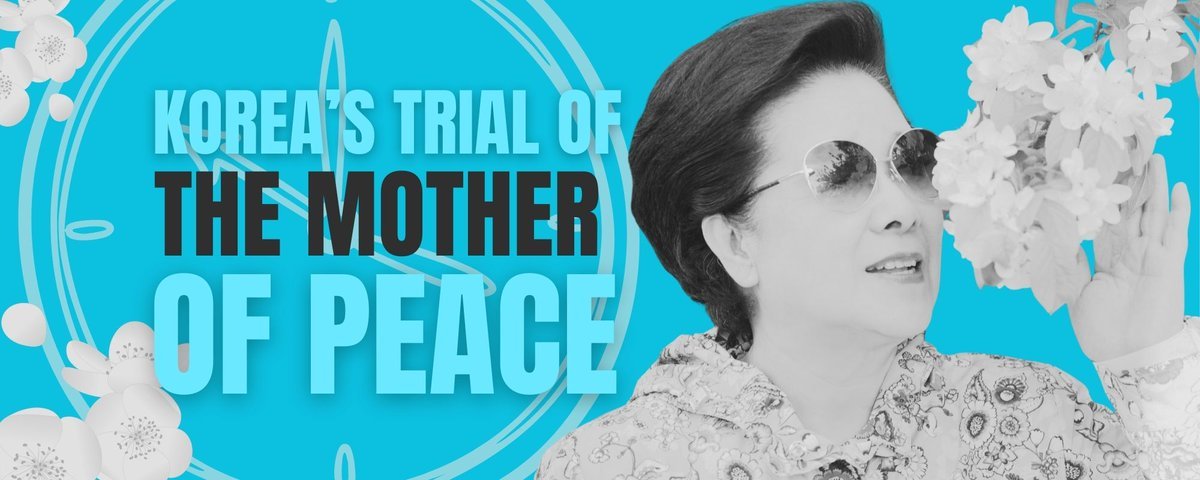
Korea’s Trial of the Mother of Peace: What Shifted, and Where the Pressure Now Lies
by Rev. Demian Dunkley
On December 1, 2025, the trial of Dr. Hak Ja Han, known globally as the Mother of Peace, formally opened at the Seoul Central District Court. Since then, the proceedings have moved steadily into public view, revealing the broader tension between faith, law, and power in today’s Korea.
What began as a side investigation into political donations, replete with exaggerated raids, selective media leaks, and marathon interrogations, has evolved. It has shifted into something more systemic, more political, and far more consequential. It is no longer a side investigation. It increasingly bears the imprint of presidential authority, and the direction of escalation points unmistakably upward.
At stake is not simply criminal liability, but whether executive power is now being used to redefine the acceptable boundaries of religious participation in public life.
The Split-Donations Testimony
It was revealed that as early as August 2025, during the investigative phase, former Family Federation executive Yun Young-ho told prosecutors that political outreach had been conducted toward both major parties in the lead-up to the 2022 presidential election. “Support was provided to both,” he said. According to multiple sources, he named politicians from both the People Power Party and the Democratic Party, including minister-level officials.
This information was completely suppressed, remaining behind closed doors until early December, when it began to surface in legal and media circles, as well as through Yun’s own testimony in court. Until that point, the entire framing of the case was built around a one-sided narrative that the Unification Church had targeted conservative figures to buy influence.
Once that narrative cracked, it was no longer an optics problem. It became a system-wide exposure.
The prosecution’s case appeared to be in serious trouble, and this development was likely deeply concerning to President Lee. During a December 2 Cabinet meeting, Lee raised the possibility of dissolving religious organizations that intervene in politics. He did not name the Family Federation, but the implication was widely understood.
“If a religious organization persistently commits serious illegal acts and systematically intervenes in politics,” he said, “we should review the possibility of dissolution as is done in Japan.”
The escalation did not stop there. On December 9, President Lee returned to the issue in a second Cabinet meeting, this time with sharper language and clearer direction. He stated that if a religious organization had become a conduit for illegal political lobbying and showed resistance to reform, dismantlement must be considered. Again invoking Japan’s precedent, he instructed legal experts to examine every available option.
The shift was decisive. What had been viewed days earlier as a conditional warning now took on the character of policy exploration. Dissolution was no longer a rhetorical boundary marker, this moment marked the first time a sitting president publicly raised the dismantling of a major religious organization during an active criminal case.
Behind the scenes, reports suggested real differences of opinion within the ruling party. Legal experts quietly acknowledged that dissolution would be extremely difficult and potentially unconstitutional. Some observers speculated that the comments were intended as a warning rather than a concrete legal plan.
December 15: The Raids and the Shift to Forensic Strategy
On December 15, investigators under the authority of the national police carried out coordinated search-and-seizure operations at ten locations connected to the case. These included Cheon Jeong Palace in Gapyeong, the Seoul headquarters of the church, the detention facility where Dr. Han and Yun Young-ho are being held, and the homes or offices of several former political figures from both major parties.
These raids were not symbolic. Investigators sought accounting ledgers, financial records, internal correspondence, digital devices, and administrative files. This suggests that authorities moved beyond reliance on testimony alone and began assembling a documentary and forensic record. Rather than building the case primarily through witness narratives, investigators appeared intent on reconstructing the flow of funds and decision-making processes through hard evidence.
This shift reinforced the sense that the investigation was being reframed as systemic, with a focus on institutional structures rather than isolated acts.
Inside the Courtroom: Separating Individuals From Institutions
Meanwhile, the trial of Dr. Han continued.
On December 19, during a critical hearing, multiple current and former church officials testified that strategic decisions related to political outreach were driven primarily by Yun himself. Reports and meeting minutes submitted to Dr. Han were described as vague, ceremonial, and lacking actionable instruction. One witness confirmed that decisions were executed without her direct approval and were often interpreted secondhand through staff.
The cumulative effect did not end the prosecution’s case, but it did begin to separate individual initiative from institutional intent. More importantly, it began to distinguish Dr. Han from the operational core of the alleged wrongdoing.
Political Pressure Mounts
By late December, the case no longer appeared to be a standard criminal process. It had taken on the characteristics of a political confrontation, with competing narratives pulling in opposite directions and Dr. Han positioned at the center.
There was discussion within the National Assembly about appointing a second special prosecutor. This was notable, given that the ruling party held a majority and that any expanded investigation could potentially expose its own members. However, the discussion quickly collapsed.
The point of failure was scope. Lawmakers aligned with the administration pushed for a narrow inquiry focused only on the church’s alleged ties to conservative figures. Opposition leaders, citing Yun’s public testimony and existing investigative records, argued that Democratic Party officials must also fall within the mandate. The disagreement proved insurmountable.
Negotiations stalled. The Assembly deadlocked.
Under those conditions, decisive authority reverted to the executive.
January 6 and the Creation of the Joint Investigation Headquarters
On January 6, 2026, upon Lee’s instruction, the Supreme Prosecutors’ Office announced the formation of a new Joint Investigation Headquarters for Religious-Political Collusion.
The team is not symbolic. It is staffed, operational, and empowered to conduct full-scale investigations, request warrants, prepare indictments, and perform legal strategy reviews.
The headquarters is led by Chief Prosecutor Kim Tae-hoon, a figure closely aligned with the current administration. He previously handled disciplinary actions against former Prosecutor General Yun Suk Yeol and was promoted under the Lee government.
Two senior prosecutors have been dispatched. Kim Jeong-hwan is a specialist in financial crime and asset tracing, known for tracking donation flows and off-ledger transactions. Lee Han-ul is a specialist in politically sensitive investigations and has handled cases involving high public volatility.
This structure looks permanent, not temporary. It mirrors an anti-corruption unit and has full authority to pursue warrants, conduct audits, and prepare indictments.
This represents not caution, but escalation. It is an assertion of state power at a moment when judicial uncertainty had increased rather than decreased.
The message is clear. The state is no longer treating this as a case of individual misconduct. It is treating it as institutional collusion between religion and politics, and the Family Federation is the first test case.
Therefore, it is reasonable to infer that prosecutors are preparing for landmark legal rulings rather than short-term media impact. The emphasis appears to be shifting toward forensic audits, donor trails, asset mapping, and internal decision-making records. In this context, documents and financial data will play a larger role than testimony alone.
For Dr. Han, the implications are mixed. It may become increasingly difficult for either the special prosecutor or the joint investigation unit to establish her direct liability. As a spiritual leader, she does not manage day-to-day operations or administrative communications, and testimony to date has confirmed her distance from operational decision-making. At the same time, the broader institutional risk to the church and its leadership structure has increased.
While no formal legal move toward dissolution has been initiated, the government’s public posture makes clear that this is not being treated as an ordinary criminal case. It is being positioned as a test of the church’s legitimacy in the public square.
The Road Ahead: Two Tracks, One Tension
At this point, the case is moving along two distinct but related tracks.
The first is the trial itself. Hearings will continue through January, with cross-examinations of key witnesses scheduled to begin in February. Additional hearings are already scheduled into March. Unless new indictments are filed, the current detention period is governed by a statutory deadline in mid-April. These are fixed legal realities, not predictions.
The second track is the joint investigation headquarters created under executive authority. This inquiry is not bound to the trial calendar and does not automatically determine the outcome of the case before the court. Its scope is broader, its timeline more flexible, and its impact potentially more political than judicial.
Understanding this separation is essential. The trial will rise or fall on evidence tested in court. The broader investigation will shape the environment around the case, including public perception, institutional pressure, and long-term consequences for the movement. While there should be a legal firewall between the two processes, assuming that separation will be perfectly maintained in practice may be unwise.
What Has Changed, and What Has Not
What has changed is the expressed posture of the state. The case has moved from an investigation framed around individual allegations to a wider effort that treats religious and political interaction as a systemic problem. This shift explains the escalation in rhetoric, the discussion of dissolution, and the creation of new investigative structures.
What has not changed is the legal standard before the court. Individual criminal responsibility must still be proven with admissible evidence. Testimony so far has continued to distinguish between personal initiative and institutional intent, and no direct instruction linking Dr. Han to illegal acts has been produced.
What also has not changed is the character and record of the Mother of Peace herself. Her life, work, and leadership remain what they have always been, regardless of how the political climate shifts around her.
Staying Clear in a Time of Pressure
Legally speaking, the Family Federation is not on trial as a faith. It is being tested as a Korean institution. In a broader sense, Korea itself is being tested.
To date, the state, the justice system, and the media have not demonstrated fair treatment of Dr. Han. What remains to be seen is whether the legal process will ultimately correct that imbalance.
Dr. Hak Ja Han is not in the public eye because of proven wrongdoing. She is there because the state has chosen to test how far executive power can reach when a religious institution becomes politically inconvenient.
What is unfolding is no longer just a criminal proceeding. It is a stress test of constitutional restraint—of whether Korea’s legal system can hold its line when political authority, prosecutorial power, and public narrative begin to converge.
History will not judge this moment by the volume of accusations or the efficiency of investigations. It will judge whether the rule of law remained distinct from political ambition when the two came into direct contact.
More than any single verdict, that is the question that is now on trial.
Sources and Background
This article draws on a combination of court records, mainstream Korean media reporting, official government statements, expert legal analysis, and publicly documented commentary on legal, political, and religious freedom concerns in South Korea.
Court Proceedings and Legal Record
Seoul Central District Court trial proceedings involving Dr. Hak Ja Han, including witness testimony, judicial inquiry, and evidentiary disputes regarding political funds, institutional command structures, and criminal liability.
Court pool reporting from accredited journalists observing the trial, documenting testimonies by former executives distancing Dr. Han from operational decisions and expanding the scope of political actors implicated.
Statements from the Special Prosecutor’s Office, as well as defense counsel, regarding the credibility of the Yoon Young-ho protocols and the timeline contradictions that undermine prosecutorial claims.
Mainstream Korean Media Reporting
KBS News: Coverage of the formation of the joint investigation headquarters, expanded allegations of political collusion involving multiple parties, and law enforcement's shift toward forensic evidence collection.
Hankyoreh (Hani): In-depth analysis of the prosecutorial strategy, internal church planning documents presented in court, and broader political conflict around the investigation’s scope and legitimacy.
Segye Ilbo: Reporting on former leadership testimony and political outreach prior to the 2022 election; disclosure of internal meeting records and communication protocols.
Yonhap News Agency: Coverage of the December raids, search-and-seizure operations, and updates on the joint investigation team’s activities following directives from the executive branch.
Korea Times / Korea Herald / JoongAng Ilbo: Commentary and reporting on court developments, calls for procedural fairness, and editorials questioning the blurring of lines between legal proceedings and political pressure.
AsiaToday: Editorial concerns about state overreach and the precedent risk of government-led efforts to dissolve a religious organization based on politicized claims.
Government Statements and Political Context
Televised Cabinet meetings on December 2 and December 9, 2025, during which President Lee Jae-myung raised the issue of disbanding religious groups that “systematically intervene in politics,” explicitly referencing Japan’s approach.
Statements by members of the National Assembly from both the ruling Democratic Party and the opposition People Power Party, revealing political disagreement over the proposed scope of a second special prosecutor.
Executive action on January 6, 2026, creating the Joint Investigation Headquarters for Religious–Political Collusion, led by prosecutors and coordinated with police under the authority of the Supreme Prosecutors’ Office.
Religious Freedom and Civil Society Responses
Public statements from Korean Christian alliances and international religious leaders warning against dissolution rhetoric and calling for legal restraint and constitutional adherence.
Joint declarations from interfaith coalitions expressing concern over selective prosecution and the erosion of protections for religious minority groups.
Medical and Humanitarian Documentation
Medical opinion submitted by Dr. Samia Burton, MD (October 22, 2025), detailing elevated cardiovascular and systemic risks associated with extended pretrial detention of Dr. Hak Ja Han under current conditions.
Geriatric health assessments and comparative detention standards, emphasizing the increased vulnerability of elderly detainees and the lack of access to appropriate medical oversight.
Prior Analysis and Contextual Work
Published op-eds and articles by the author, including “Release the Mother of Peace” and related commentary on state-religion dynamics and the legal treatment of religious leadership.
Research on the special prosecutor system in Korea, examining its evolution, statutory structure, and increasing use in politically sensitive investigations.
Comparative legal studies referencing Japan’s dissolution of the Unification Church, providing background on the use of state authority to regulate or disband religious institutions and the ensuing public backlash.